
If you’re investing time and energy into short-form video content — great! Short videos are one of the most powerful ways to get in front of your audience today. But here’s the truth: not all short-form platforms are equal when it comes to driving real website traffic, leads, and revenue. Just because a video gets likes doesn’t mean it’s sending people off the platform and onto your site — where conversions and leads actually happen.
Let’s take a clear look at the three biggest players — Facebook Reels, Instagram Reels, and YouTube Shorts — and break down which ones are actually effective at driving traffic to your website.
Why Website Traffic Matters More Than Engagement Metrics
Likes, shares, and views feel good — but they don’t guarantee leads. Website traffic does.
Traffic that you can:
-
Track in Google Analytics
-
Convert into forms, calls, or purchases
-
Remarket to later
That’s what drives actual revenue.
Understanding Social Referral Traffic Trends
Before comparing Reels and Shorts, it’s worth seeing where social media fits overall:
- In a recent global study of web traffic sources, social platforms accounted for about 10.12% of all website traffic worldwide — meaning roughly one in ten site visits originated from social channels. Social referrals are real and measurable.
- Within that social traffic share, Facebook was the largest single source of social referrals, followed by Instagram and other platforms.
This tells us social video platforms matter — but which formats actually drive clicks?
Facebook Reels — Best for Direct Website Traffic
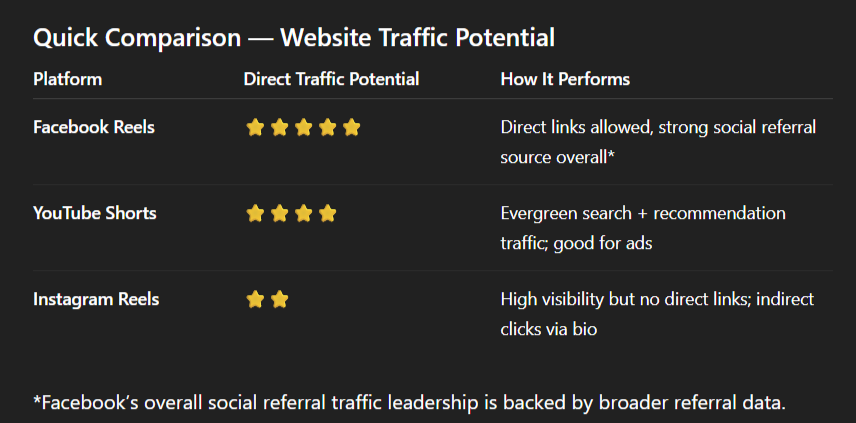
When it comes to real referral traffic, Facebook is still a heavyweight among social platforms. In analyses of social media referral trends, Facebook consistently ranks first in sending users from social platforms back to websites — meaning people leave Facebook and click through to external pages more often than on other networks.
Why this matters for Reels:
-
Facebook allows clickable links directly in Reels captions and descriptions.
-
Users don’t have to hunt through your profile to find a link.
-
This reduces friction, increasing the chances someone actually visits your website.
This friction-free path makes Facebook Reels especially strong for businesses whose goal is lead capture, service pages, appointment requests, or contact form submissions.
Instagram Reels — Visibility Isn’t the Same as Traffic
Instagram Reels are great for reach — there’s no denying that. They can put your brand in front of thousands of eyeballs fast. But there’s a major catch when it comes to traffic:
👉 You cannot include clickable links directly in Instagram Reels.
That means a user has to:
-
Watch a Reel
-
Go to your profile
-
Find the link in your bio
-
Then click through to your website
That multi-step path loses a lot of traffic along the way — especially compared to Facebook, where one click can take someone straight from video to site.
Most social strategy guides today point this out when they talk about Reels not being direct traffic machines — even though they still offer strong brand awareness and community connection.
Instagram excels at awareness and brand affinity, but it’s not optimized for direct traffic.
YouTube Shorts — Long-Term Discovery Traffic
YouTube is a different beast because it functions partially like a search engine and partially like a social feed.
Here’s the key:
-
Shorts can be discovered via search, suggested videos, and recommendations long after you post them.
-
You can link to your website through your channel’s profile and video descriptions, which means Shorts can continue generating traffic over time.
In industry ad tests comparing identical video creatives across platforms, YouTube Shorts drove more clicks to external websites than Instagram Reels — showing their strength as a traffic driver when link placement is included.
This long-shelf-life characteristic makes Shorts valuable if you’re prioritizing evergreen content and ongoing discovery.
What Studies Show (2024–2026)
Recent research confirms the patterns we see across platforms — and why Facebook Reels often outperform the others in terms of traffic:
-
Social Platforms Drive Real Website Visits
Social media now accounts for about 10 % of global website traffic, meaning social platforms are real sources of visitors, not just engagement. (seranking.com) -
Facebook Leads Social Referral Traffic
Referral tracking shows Facebook consistently drives the largest portion of social traffic to external websites, accounting for roughly 74 % of all social referrals in 2025. (visual-nerd.com) -
Instagram and YouTube Contribute, but Less
Instagram typically accounts for 10–18 % of social referral traffic, while YouTube contributes a smaller but measurable share. (socialpulsestats.com) -
Publishers See Growing Social Referral Traffic
A 2025 Digiday survey found that nearly half of publishers reported increases in social referral traffic, with Meta platforms (Facebook + Instagram) leading the gains. (digiday.com) -
Short-Form Video Growth Continues
Short-form video content continues its rapid growth, but studies show that reach and views alone don’t guarantee traffic — platform mechanics (like clickable links and discovery algorithms) are what influence actual website visits. (metricool.com)
Key Takeaways from Studies:
-
Social platforms are legitimate sources of website traffic
-
Facebook is the most effective single platform for referrals
-
Instagram and YouTube matter, but mechanics limit direct clicks
-
Short-form video growth is strong, but traffic depends on links and platform behavior
How They Stack Up: Website Traffic Potential
What This Means for Your Marketing Plan
Here’s a simple way to think about it:
👉 Use Facebook Reels when your goal is direct traffic and leads
If you want people to visit your website and take action, Facebook Reels should be part of your content mix. Its link-friendly format removes barriers and helps turn viewers into visitors.
👉 Use YouTube Shorts to build long-term discoverability
Shorts are fantastic for reaching people over time. Because YouTube experiences ongoing discovery through search and recommendations, well-optimized Shorts can continue attracting viewers — and eventually website visitors — well after they’re published.
👉 Use Instagram Reels for visibility and engagement
Reels are excellent for staying top-of-mind, showcasing your brand personality, and growing your community — but don’t rely on them as your main traffic driver.
Final Takeaway
Not all short-form video platforms deliver the same business value. Likes feel good, but what delivers leads and revenue is traffic that lands on your website and converts.
If you’re focusing on real results — traffic, leads, and conversions — then prioritizing platforms like Facebook Reels and YouTube Shorts, alongside a smart strategy for Instagram, will put you in the best position to grow.