Social media is deeply woven into our daily lives — from keeping up with friends to catching breaking news. But not all platforms are equal when it comes to negativity. Recent studies (2024–2025) highlight how different apps affect mental health, foster toxic interactions, or spread misinformation. Here’s a rundown, starting with the least toxic platform and moving toward the worst offenders.
Key Findings: Social Media, Toxicity, and Mental Health
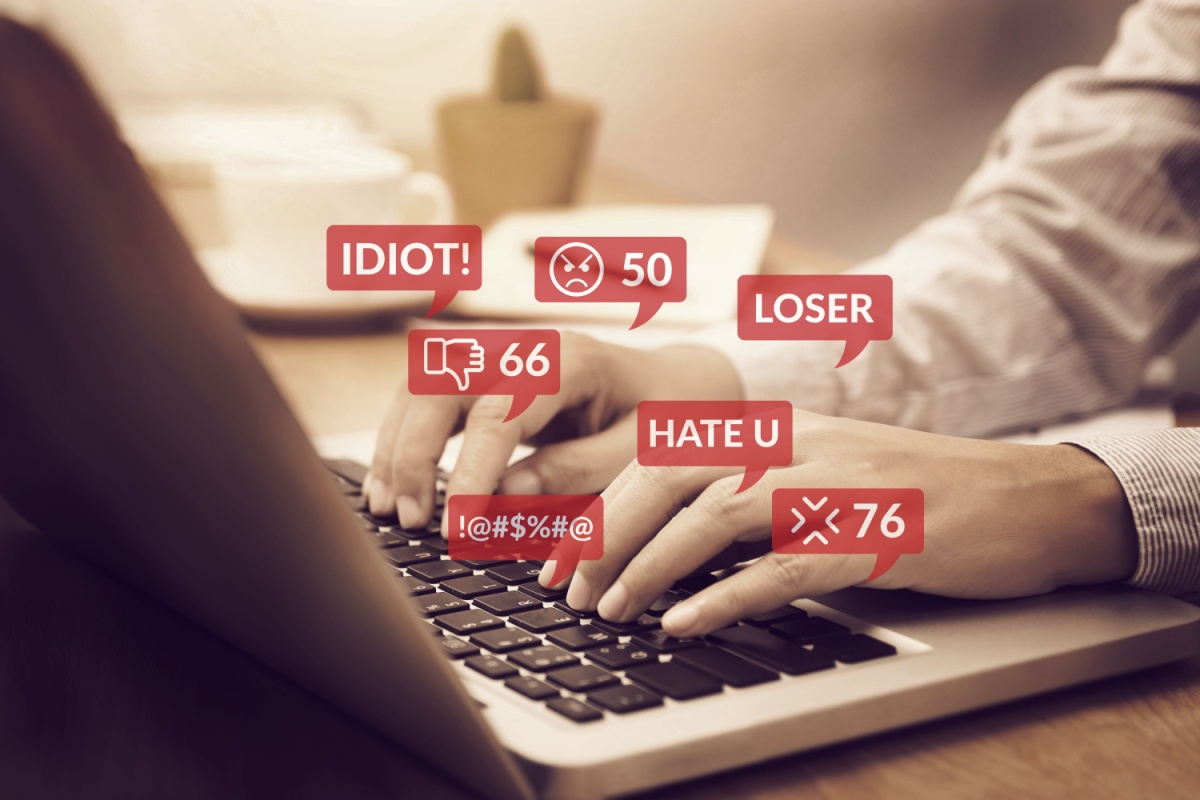
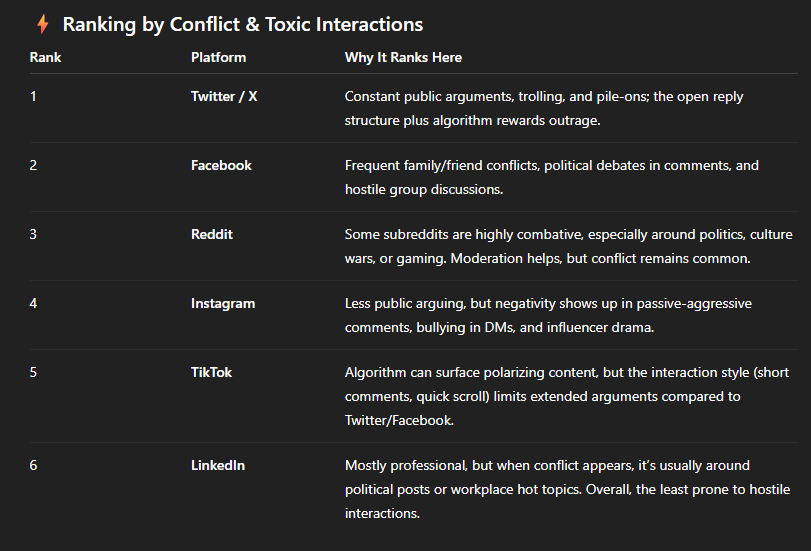
Toxic Content & Conflict
-
Twitter / X: Hostile Interactions
-
Frequently ranked as the most toxic platform due to trolling, pile-ons, and political hostility.
-
Study on misinformation correction found that Community Notes often triggered more anger, disgust, and outrage in replies, showing how easily the platform escalates negativity.
-
Source: arXiv preprint, 2024
-
-
Facebook: Harassment at Scale
-
A 2025 global survey of climate and land defenders found 62% had experienced online abuse on Facebook — higher than on any other mainstream platform.
-
Women and activists are particularly targeted.
-
-
Reddit: Subcommunity Variability
-
Some subreddits are supportive, but others (politics, culture wars) foster insults and toxic debates.
-
European Observatory of Online Hate (2025) ranked Reddit among the higher-toxicity platforms, though lower than fringe sites like 4chan.
-
-
TikTok: Misinformation Risks
-
A Guardian investigation found that more than half of the top 100 #mentalhealthtips TikToks contained misinformation.
-
This misinformation can lead to confusion, self-diagnosis, and harmful practices.
-
Source: The Guardian, 2025
-
-
Instagram: Harassment via DMs
-
While less hostile than Facebook or Twitter, Instagram is still a site of bullying, especially in direct messages.
-
Negative interactions often involve body image commentary or influencer drama.
-
-
LinkedIn: Least Toxic
-
Lowest levels of harassment compared to other platforms.
-
Negativity limited mostly to workplace competitiveness, subtle political debates, or spam.
-
Source: Pew reports on online harassment; comparative toxicity surveys 2022–2025.
-
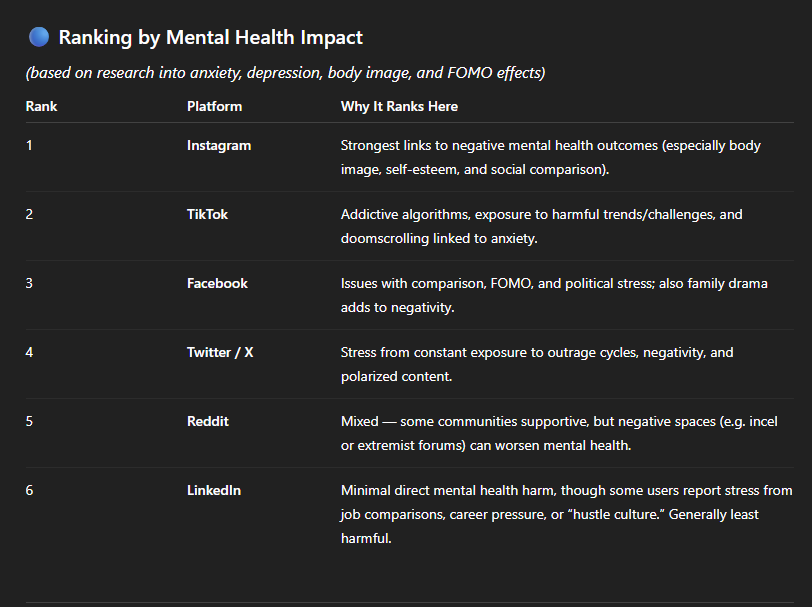
Mental Health Impact
-
Instagram: Strongest Negative Association
-
Heavy Instagram use (>3 hrs/day) linked to higher depression, anxiety, and stress among emerging adults.
-
Taking breaks improves well-being for young women: one study showed a 40% improvement in anxiety/depression scores after a short Instagram break.
-
Sources: PMC cross-sectional study, 2024 | Tanya Goodin study summary, 2025
-
-
TikTok: Addictive and Stress-Inducing
-
A 2025 study of 575 young adults found TikTok use was consistently associated with more mental health issues.
-
CDC data showed frequent teen use linked to bullying victimization, persistent sadness, and increased suicide risk factors.
-
Sources: Springer Nature study, 2025 | CDC YRBS Survey, 2023
-
-
Facebook: Stress and Comparison
-
Users report stress from political conflict, family disputes, and social comparison.
-
Overuse linked to greater risk of sadness and hopelessness among adolescents.
-
Source: CDC YRBS Survey, 2023
-
-
Twitter / X: Outrage Cycles
-
Constant exposure to outrage and divisive news fuels anxiety and stress.
-
Problematic use correlates with higher depressive symptoms in youth already in treatment.
-
Source: UT Southwestern study, 2025
-
-
Reddit: Mixed Outcomes
-
Supportive communities (e.g., health forums, hobby groups) can buffer mental health.
-
Toxic subreddits (e.g., extremist, incel spaces) are associated with worsening symptoms.
-
Source: Springer Nature study, 2025
-
-
LinkedIn: Minimal Impact
-
Least harmful overall, though some users report stress from job comparisons and “hustle culture.”
-
Not strongly associated with depression or anxiety in current research.
-
Source: General findings from cross-platform studies on stress and social comparison.
-
6. LinkedIn – The Least Toxic
LinkedIn consistently comes out as the “safest” of the major social media platforms. Negativity is rare, and harassment levels are significantly lower compared to other networks.
That said, studies do show some subtle downsides. Users often feel stress from career comparisons, hustle culture, or the pressure to constantly “perform” professionally. Still, compared to other platforms, LinkedIn remains a relatively low-conflict environment.
5. Reddit – A Mixed Bag
Reddit is home to thousands of communities (subreddits), ranging from wholesome support groups to deeply combative forums. Recent research found that men in particular report stronger negative mental health effects from Reddit use, often tied to conflict-heavy or extremist spaces.
At the same time, many subreddits provide genuine support and connection, proving that how you use Reddit matters more than just the time spent.
4. Instagram – Pretty Pictures, Hidden Pressure
Instagram’s polished aesthetic comes at a cost. Multiple studies show heavy Instagram use (over three hours daily) is associated with higher levels of depression, anxiety, and stress. Young women are especially vulnerable to body image issues and harmful comparison cycles.
The good news? Taking breaks helps. A 2025 study found that stepping away from Instagram for even a short period significantly improved well-being for women ages 18–24.
3. TikTok – Addictive but Risky
TikTok has exploded in popularity, especially among younger users, but researchers are increasingly sounding alarms. A 2025 study of young adults found TikTok use consistently linked to worse mental health outcomes. Another CDC survey tied frequent TikTok use among teens to higher rates of bullying victimization and sadness.
Beyond mental health, misinformation is a major issue: over half of the top #mentalhealthtips TikToks contained misleading or outright false claims. The app’s algorithm also promotes divisive or harmful trends, making it fun but potentially dangerous.
2. Facebook – Conflict at Scale
Facebook remains a dominant force globally — and one of the most reported platforms for harassment. Activists, women, and young users especially point to Facebook as a space where abuse and divisive arguments are common.
Mental health studies also show that Facebook contributes to stress through comparison, political conflict, and even family drama. Its sheer scale makes it fertile ground for toxic interactions.
1. Twitter / X – The Most Toxic
At the very top of the toxicity scale sits Twitter, now known as X. It’s consistently ranked the most hostile major platform, with trolling, harassment, and public pile-ons driving many users away.
One study even found that when misinformation is corrected on X (via “Community Notes”), the replies often increase in anger, disgust, and outrage — showing how easily the platform spirals into negativity. Combined with constant outrage cycles, it’s no surprise X ranks worst for both conflict and mental health strain.
The Bottom Line
Social media isn’t all bad — it connects, entertains, and informs. But the risks vary widely depending on the platform. LinkedIn and Reddit can be relatively safe spaces, while Instagram and TikTok pose more mental health risks. Facebook and Twitter/X, however, remain the most toxic in terms of conflict, harassment, and divisive content.
If you want to improve your relationship with social media, the evidence suggests:
- Limit time on high-impact platforms like Instagram and TikTok.
- Take breaks to reset your mental health.
- Curate your feeds and communities, especially on Reddit and Facebook.